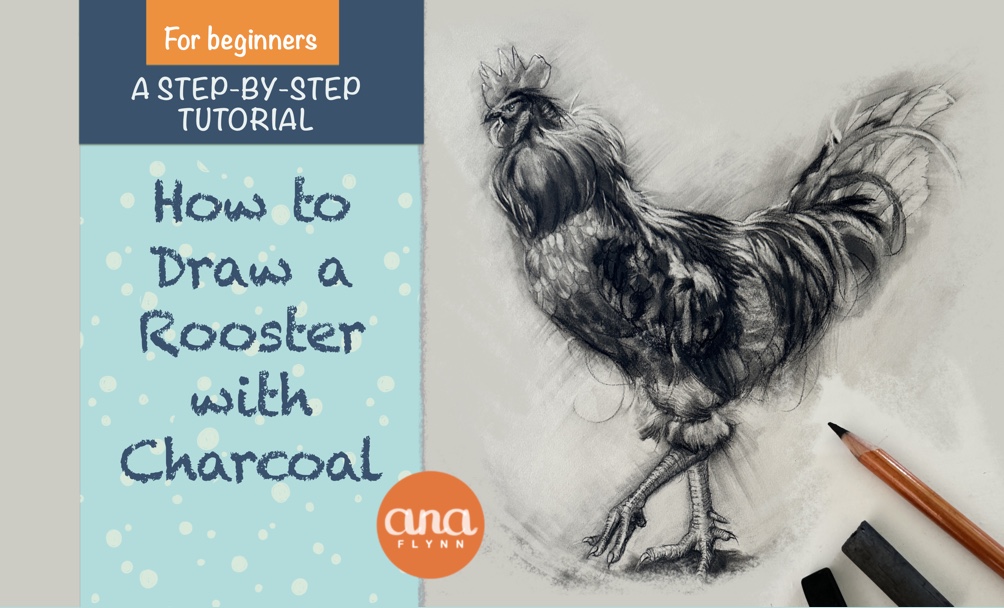
You can use any materials you like for this tutorial. I like working with a variety of charcoal sticks and pencils in different sizes. There are good, better, and best brand options when it comes to these supplies. You can easily find these supplies online or at your favorite arts and crafts store.
🎨 Materials I Used
Want to try this yourself? Here’s a list of the exact pencils, paper, and tools I use for this exercise. Check out my drawing supply list here → (affiliate link — I may earn a small commission at no extra cost to you!)
–A picture of a rooster from your reference library. Make sure to use your own pictures to avoid using copyrighted material.
-Charcoal pencils. I mostly use these sizes: 2H, HB, 2B, 4B, 6B
-Vine charcoal (Thin ones for sketching and shading)
-Kneaded eraser
-Paper towels or napkins
-Dry media paper
-Fixative spray (optional but recommended)
Step 1: Start with a Light Sketch
Using a vine charcoal stick, begin by lightly sketching the basic shapes. You can break the stick in half for a better grip. I usually start by drawing a big, egg-like oval shape for the body at the center of the page, and I add a small one for the head. Then, I block a square-like shape for the tail, draw small angular shapes for the beak; and lastly, I add a jagged crown shape for the comb and thin sticks for the legs.
💡 Tip: Keep your hand loose and your strokes light. You’ll refine them later.
Step 2: Define Proportions and Contour
Once the basic shape feels right, refine the outline with a compressed charcoal stick. Add more definition to the following:
- The beak, with a sharp curve and open or closed mouth
- The comb and wattles, giving them a wavy, irregular edge
- The tail feathers, using long, expressive lines
- The legs, with attention to the joints and claws
Step 3: Add Texture and Shadow
Use any of your charcoal tools to build shadows and define form. Follow your reference to aid your drawing with the right values. The following are suggestions to accomplish this step:
- Shade the underbelly, neck, and parts of the wings where light doesn’t hit
- Use one of your favorite erasers or a paper towel to soften shadows and create smooth gradients
- Add contrast by darkening the eye, comb, and tail feathers with a compressed charcoal stick or pencils
💡Observe real rooster photos or a reference image for light direction.
Step 4: Add Feather Details
To this point, you may have noticed that feathers vary in texture and direction. Use well-sharpened pencils and less speed to accomplish this:
- On the neck (hackles): Short, sharp strokes downward
- Wings and body: Use overlapping curved lines
- Tail: Long, flowing strokes with expressive curvature
💡Avoid over-detailing — let charcoal’s expressive nature suggest texture rather than define every feather. You can do this by paying attention to soft and hard edges.
Step 5: Lift Highlights
Use a kneaded eraser to pull out highlights:
- On the comb and wattles, where light hits
- On the beak and eye, to give a glossy, lively effect
- On feathers, to give volume and light reflection
💡You can pinch the eraser into a point to lift thin highlights along the feather edges.
Step 6: Final Touches
- Deepen shadows where needed for more contrast, taking into consideration how the design plays in the composition
- Use a white, sharp charcoal pencil to add some crisp lines in the beak and claws
- Gently blow or tap off excess dust (don’t smear)
- Spray fixative to prevent smudging. This is optional. I usually don’t do it because it makes my drawings look darker and loses the subtle quality of the value ranges.
Done!
Bonus Tips:
💡Charcoal is forgiving — you can erase and redraw easily. Try not to apply too much pressure in the beginning stage
💡Test your drawing tools on a scrap piece of the same paper you are using
💡Test drawing different feather types on scrap paper
💡Sketch several roosters from different angles for variety and challenge before starting your masterpiece